Best Cloud Course for Beginners in 2026: A Strategic Guide to Starting Your Cloud Journey
If you’re looking for the best cloud course for beginners, you’re probably at one of two points:
Either you’re starting a tech career from scratch (maybe from a completely unrelated field like marketing, finance, or hospitality), or you’re already in IT, perhaps working helpdesk or desktop support, and want to finally level up into the cloud space where the real career growth is happening.
Either way… Welcome! You’re in the right place.
If you’re completely new, I strongly recommend starting with a clear foundation — here’s my full breakdown of Cloud Computing Fundamentals: The Beginner’s Guide to Getting Started.
I remember Googling everything from “What is the cloud?” to “Which certification matters?” and getting completely overwhelmed. One minute I was reading about AWS, the next I was watching YouTube videos on Google Cloud, and then suddenly I was deep in Reddit threads comparing bootcamps. The information overload was real, and it paralyzed me for weeks.
Cloud moves fast. And if you’re not careful, it’s easy to get stuck in analysis paralysis or worse — tutorial purgatory, where you watch course after course but never actually build anything or move your career forward.
That’s why I created this guide.
Not to throw a hundred courses at you and leave you more confused, but to help you identify the best cloud course for beginners that matches your learning style, avoid wasting time and money, and actually move forward with confidence and clarity.
👉 My Beginner Recommendation:
Start with a concept first cloud fundamentals course on Udemy. It’s affordable (often $10 to $20 during sales), self paced so you can learn around your current job, and specifically designed for beginners who want clarity before diving into expensive certifications.
The best cloud courses for beginners on Udemy typically range from 8 to 20 hours of content, include hands on demos, and come with lifetime access, meaning you can revisit concepts whenever you need a refresher.
👉 Browse the best cloud course for beginners on Udemy
What to Do After Video Courses Start to Click
Video-based courses are the best way to get your bearings early on. They help you see the cloud, hear concepts explained, and understand how services fit together.
But at some point, many learners hit a wall: you understand the ideas, but you don’t yet feel sharp applying them.
That’s where text-based, interactive learning platforms like Educative become incredibly valuable.
Educative focuses on problem-solving, scenario-based explanations, and hands-on reasoning — the kind of practice that prepares you for real-world work and technical interviews, not just watching along with a video.
👉 Explore hands-on cloud learning paths on Educative
🎯 What Makes a Cloud Course Ideal for Beginners?
Not all cloud courses are created equal, especially when you’re just starting out and don’t yet have the context to separate quality from hype.
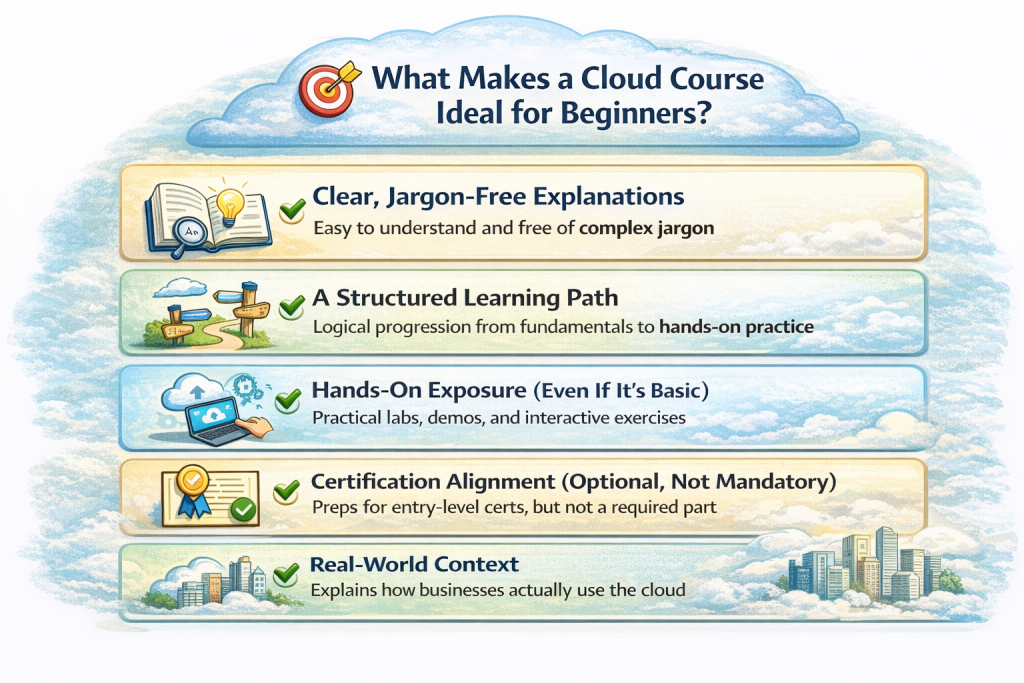
The best cloud courses for beginners don’t just explain buzzwords like IaaS, PaaS, or multi cloud architecture. They walk you step by step from zero → understanding → confidence, building on each concept logically so you’re never lost or confused about why something matters.
Here’s what actually matters when evaluating whether a course is truly beginner friendly:
Clear, Jargon-Free Explanations
If you need a tech dictionary to survive lesson one, it’s not beginner-friendly. Period.
The best cloud courses for beginners explain why things matter using real-world examples and analogies. For instance, explaining cloud storage by comparing it to Dropbox or Google Drive (something you already understand) rather than jumping straight into object storage protocols and API endpoints.
A Structured Learning Path
Great beginner courses follow a logical progression, from high-level concepts, to visual demos, to light hands-on exposure, without throwing everything at you at once or assuming prior knowledge you don’t have.
You should feel like each lesson builds naturally on the last, creating a foundation strong enough to support more advanced learning later.
Hands-On Exposure (Even If It’s Basic)
Watching alone isn’t enough. Even simple demos like spinning up a virtual machine, uploading a file to cloud storage, navigating IAM (Identity and Access Management) help concepts stick in a way that passive watching never will.
The best cloud courses for beginners include guided labs or console walkthroughs, even if you’re not building production systems yet. That practical exposure is what transforms abstract concepts into genuine understanding.
Certification Alignment (Optional, Not Mandatory)
Many beginner courses loosely align with entry-level certifications like AWS Cloud Practitioner, Google Cloud Digital Leader, or Azure Fundamentals (AZ-900). You don’t have to take the exam right away — but the structure helps ensure you’re learning industry-standard concepts in the right order.
This also means your learning has a clear path forward: fundamentals course → hands on projects → certification exam → job applications.
Real World Context
The best cloud course for beginners should explain how companies actually use cloud for disaster recovery, scalability, cost optimization, global reach, helping you think like a professional early on, not just a student memorizing terms for an exam.
💼 Best Cloud Platforms for Beginners (Google Cloud, AWS, Azure)
There’s no shortage of cloud platforms, but beginners usually ask the same anxious question:
Which cloud should I start with?
Here’s the honest answer:
You can’t really go wrong, the fundamentals transfer.
The core concepts of compute, storage, networking, and security work similarly across all major cloud platforms. Once you understand how virtualization works or what serverless computing means, that knowledge applies everywhere.
That said, here are the nuances:
Google Cloud (GCP)
Clean interface, strong data analytics and AI/ML services, very beginner friendly conceptually. The console is intuitive, and the documentation is excellent. Great for understanding how cloud fits into modern data driven businesses.
If you’re interested in data engineering or machine learning down the road, starting with GCP gives you early exposure to tools like BigQuery and Vertex AI.
AWS (Amazon Web Services)
The industry standard with about 32% market share. Huge ecosystem with services for virtually everything. Best choice if you want maximum job flexibility long-term — most cloud job postings mention AWS specifically.
The downside? The console can feel overwhelming at first because there are so many services. But that’s also why finding the best cloud course for beginners matters, it cuts through the noise and gives you a structured learning path.
Azure (Microsoft Azure)
Strong in enterprise environments, especially companies already using Microsoft tools like Office 365, Active Directory, and Dynamics. If you’re already in an organization that runs on Microsoft tech, Azure skills have immediate practical value.
Azure also has excellent hybrid cloud capabilities, which matters for companies that aren’t ready to go all-in on cloud yet.
👉 This is why a vendor-agnostic beginner course (like many available on Udemy) is ideal early on. You learn concepts once, then apply them anywhere. Some of the best cloud courses for beginners teach cloud fundamentals without locking you into one vendor, then let you specialize later.
If the term still feels abstract, this guide breaks it down step by step: What Is Cloud Computing? A Powerful Beginner’s Guide to Cloud Basics.
📚 Best Cloud Courses for Beginners (How to Choose, Not a Link Dump)
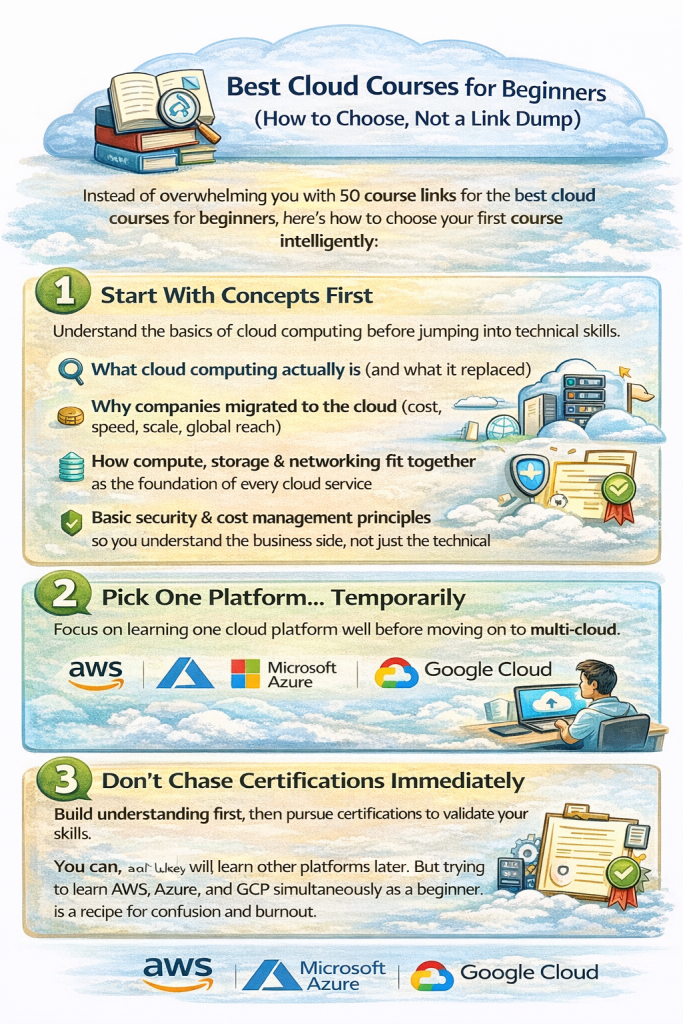
Instead of overwhelming you with 50 course links for the best cloud courses for beginners, here’s how to choose your first course intelligently:
1️⃣ Start With Concepts First
Your first course should clearly explain:
- What cloud computing actually is (and what it replaced)
- Why companies migrated to the cloud (cost, speed, scale, global reach)
- How compute, storage, and networking fit together as the foundation of every cloud service
- Basic security and cost management principles so you understand the business side, not just the technical side
If a course jumps straight into “deploying Kubernetes clusters” or “architecting for high availability,” it’s not for beginners. Save those for later.
2️⃣ Pick One Platform… Temporarily
Don’t try to “multi-cloud” as a beginner. Pick one platform, learn it well, and go deep enough to actually do things in the console. This builds confidence and muscle memory.
You can, and likely will, learn other platforms later. But trying to learn AWS, Azure, and GCP simultaneously as a beginner is a recipe for confusion and burnout.
3️⃣ Don’t Chase Certifications Immediately
Certifications matter for your resume, but they matter after understanding. Courses that rush exam prep without building foundational knowledge create fragile knowledge that crumbles under interview questions.
Learn first. Build things. Then certify to prove what you already know.
That’s why I recommend starting with a beginner cloud fundamentals course on Udemy — build understanding and confidence first, then layer certifications and advanced specializations later when you’re ready.
👉 Browse the best cloud course for beginners on Udemy
🧩 Should You Learn Google Cloud, AWS, or Azure First?
Here’s my honest take based on where you are and where you want to go:
If you’re brand new to tech: Google Cloud or AWS
Focus on concept clarity over job postings initially. Both platforms have excellent beginner resources, clean interfaces, and generous free tiers for hands-on practice.
If you want maximum job options: AWS
It dominates the market, and most cloud job postings mention AWS specifically. Learning AWS first gives you the most doors to knock on when job hunting.
If you’re already in a Microsoft-heavy environment: Azure
You’ll see immediate practical value, understand how cloud integrates with tools you already use, and can more easily demonstrate value to your current employer (which might lead to an internal role change before you even apply elsewhere).
The key thing to remember:
Cloud concepts transfer. Your first platform is not your last platform.
Pick one. Stick with it long enough to build real confidence. Then expand if your career requires it. Many cloud engineers eventually work across multiple platforms, but they didn’t start that way.
🛠 Hands-On Labs & Beginner Projects (Non-Negotiable)
This is where things really click, and where many beginners get stuck.
At first, I watched courses passively, nodding along like I understood everything. Then I opened an actual cloud console for the first time and froze. IAM roles. Permissions. Billing alerts. Hundreds of services everywhere. Nothing looked like the neat diagrams from the videos.
The turning point? Doing.
Some learners prefer learning by watching first. Others retain information better by reading, thinking through problems, and applying concepts step by step.
If you’re in the second group, platforms like Educative can be a strong complement to video courses. Their text-based cloud lessons walk you through real scenarios, design decisions, and hands-on reasoning without relying on passive video consumption.
This combination — video for intuition, text-based practice for mastery — is how many beginners turn understanding into real skill.
Even clumsy, messy, mistake-filled doing. That’s when concepts stopped being abstract and started being tools I could actually use.
Beginner friendly project ideas:
- Deploy a static website using cloud storage (S3, Cloud Storage, or Blob Storage)
- Spin up a virtual machine and configure basic firewall rules
- Upload data to cloud storage and manage file permissions
- Create a basic serverless function (Lambda, Cloud Functions, or Azure Functions) that responds to an event
- Set up a simple database and connect it to an application
You don’t need huge, complex projects right away. You need small wins that prove to yourself (and future employers) that you can navigate a cloud console and deploy real resources.
Pro tip:
Document your projects. Write simple blog posts explaining what you built and why. Screenshot your architecture. Record a short video walkthrough.
Recruiters and hiring managers love proof of practical skills. A GitHub repo with well documented beginner projects beats a resume full of buzzwords every single time.
The best cloud courses for beginners often include guided projects. Look for courses that make you build, not just watch. This hands-on component is what separates effective courses from passive video content.
🧭 Career Paths After a Beginner Cloud Course
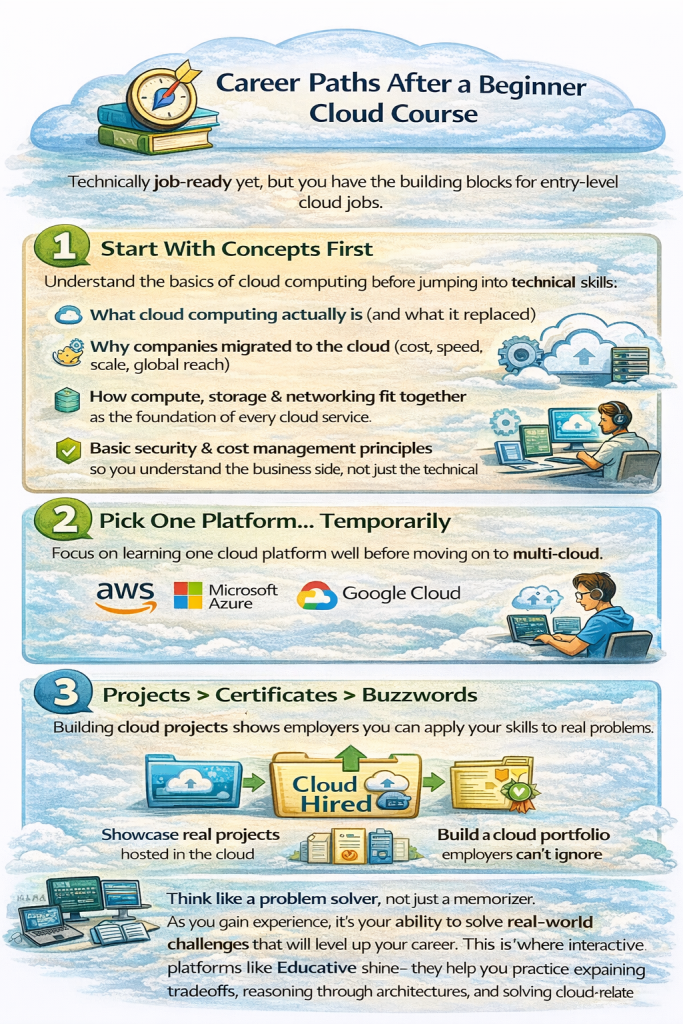
After your first course, you’re not “job-ready” in the traditional sense, but you are positioned strategically in a way that opens doors.
Common entry-level or adjacent roles:
- Cloud Support Associate: answering technical questions and troubleshooting issues
- Technical Support Engineer: helping customers configure and optimize cloud resources
- Junior Cloud Administrator: managing and monitoring cloud infrastructure
- Associate Consultant: working on cloud migration projects under senior guidance
- Entry Level DevOps (with projects and some coding knowledge)
One of the best ways to stand out is building a public cloud portfolio. For example, hosting your resume website in the cloud and documenting how you did it shows initiative and practical skills that most candidates don’t have.
Projects > Certificates > Buzzwords in terms of what actually gets you hired.
The skills you learn from the best cloud courses for beginners become immediately applicable when you start building these portfolio projects. That’s the progression that works: learn the fundamentals, apply them to real projects, then showcase your work to potential employers.
As you move closer to interviews and real-world responsibility, practicing how you think through cloud problems becomes just as important as knowing definitions.
This is where interactive platforms like Educative shine — they help you practice explaining tradeoffs, reasoning through architectures, and solving cloud-related problems in a way that mirrors real job expectations.
👉 Practice cloud problem-solving with Educative
💬 Real Student Experiences (Why This Works)
Beginners who successfully transition into cloud careers consistently say the same few things:
- “The explanations finally made sense — no more buzzword soup.”
- “I stopped watching passively and started building, even small things.”
- “Once I understood fundamentals, everything else clicked into place faster.”
- “I wish I’d started with one good course instead of trying five platforms at once.”
That’s the goal here.
Not to know everything (impossible in a field that releases new services weekly), but to know enough to keep learning, building, and progressing without feeling lost or overwhelmed.
When you choose from the best cloud courses for beginners, you’re investing in a foundation that supports years of career growth. The right starting point matters more than most people realize.
🏁 Final Thoughts on the Best Cloud Course for Beginners in 2026
There’s no shortage of cloud courses out there, but clarity beats volume every single time.
The best cloud courses for beginners share these qualities:
✅ Teach fundamentals clearly without assuming prior knowledge
✅ Give you practical confidence through hands-on exposure
✅ Help you take the next logical step in your cloud journey
You don’t need the “perfect” course. You need a good enough course that you’ll actually finish, combined with the discipline to apply what you learn through small projects and consistent practice.
🚀 My recommendation:
Start with a beginner friendly cloud fundamentals course on Udemy, build understanding through hands on practice, then layer certifications and advanced projects later as your confidence grows.
👉 Browse the best cloud course for beginners on Udemy
The best cloud course for beginners is ultimately the one you’ll actually complete and apply. Stop researching endlessly and start learning today.
💡 Final tip:
Choose one platform, one course, and one goal — then show up consistently.
That’s not sexy advice. It won’t go viral on social media. But it’s how cloud careers are actually built, one concept at a time, one project at a time, one small win at a time.
The best cloud courses for beginners are the ones you actually complete and apply. Start today, stay consistent, and trust the process. Your future cloud career is built through action, not endless research.
You’ve got this. Now go build something.
❓ Frequently Asked Questions: Best Cloud Course for Beginners
What is the best cloud course for beginners with no tech background?
The best cloud course for beginners with no technical background is one that focuses on concepts first, not tools. Look for a course that explains what cloud computing is, why companies use it, and how services like compute, storage, and networking work together—without assuming prior IT experience. The best cloud course for beginners uses real-world examples, avoids heavy jargon, and builds confidence before diving into advanced topics.
Is the best cloud course for beginners different from certification courses?
Yes. The best cloud course for beginners is designed to teach understanding, not just help you pass an exam. Certification-focused courses often rush through material and assume foundational knowledge you may not have yet. A true beginner cloud course builds clarity first, then prepares you for certifications after the concepts click. Learning fundamentals before cert prep leads to stronger interviews and real-world confidence.
How long does it take to complete the best cloud course for beginners?
Most of the best cloud courses for beginners take between 8 and 20 hours to complete. If you study a few hours per week, you can finish in 2–4 weeks comfortably. What matters more than speed is completion and application. The best cloud course for beginners is one you actually finish and use to start building small hands-on projects.
Should the best cloud course for beginners include hands-on labs?
Absolutely. The best cloud course for beginners includes at least basic hands-on exposure—such as navigating the cloud console, uploading files, launching a virtual machine, or configuring simple permissions. You don’t need complex projects at first, but touching the cloud is essential. Hands-on practice turns abstract concepts into real skills.
Is Udemy a good place to find the best cloud course for beginners?
Yes. Udemy is one of the best platforms to find a best cloud course for beginners because courses are affordable, self-paced, and beginner-focused. Many top-rated beginner cloud courses on Udemy are designed specifically for people transitioning into tech or leveling up from entry-level IT roles. Just be sure the course emphasizes fundamentals over rapid certification cramming.
Which platform should the best cloud course for beginners focus on?
The best cloud course for beginners usually starts vendor-agnostic or focuses on one platform only. AWS, Google Cloud, and Azure all work well for beginners, because cloud fundamentals transfer across platforms. The key is not which cloud you choose, but choosing one platform temporarily so you can build confidence instead of bouncing between tools.
Can the best cloud course for beginners help me get a job?
Yes—but indirectly. The best cloud course for beginners positions you for entry-level or adjacent roles by giving you foundational understanding. Pairing your course with small projects (like hosting a website or deploying a VM) is what turns learning into job-ready momentum. Employers care less about buzzwords and more about your ability to explain and apply cloud concepts.
Do I need to know coding before taking the best cloud course for beginners?
No. The best cloud course for beginners does not require coding. Many cloud roles—especially early on—focus on infrastructure concepts, troubleshooting, and system understanding. While learning basic scripting later can help, it’s not required to start. The best beginner cloud courses focus on thinking, not programming.
What should I avoid when choosing the best cloud course for beginners?
Avoid courses that:
- Jump straight into Kubernetes or advanced architecture
- Assume prior networking or Linux knowledge
- Focus only on passing an exam
- Overwhelm you with tools without explaining why they matter
The best cloud course for beginners makes things feel simpler, not more confusing.
What comes after finishing the best cloud course for beginners?
After completing the best cloud course for beginners, the next step is hands-on projects and deeper practice. This is where platforms like interactive learning tools or guided labs shine. The progression that works is:
Beginner cloud course → small projects → certification → job applications
That order matters.